If Brooke can do it, I can do it
Ataxia is a Greek word for “Lack of Order”. Our mission is to bring some order with Ataxia awareness.
As part of the Ataxia Aware project, we are sharing personal accounts of those with Ataxia or other rare conditions. We want to provide a safe space for people to talk about their experience with disability, whether themselves or someone close to them.
My Diagnosis:
I had signs of ataxia beforehand, but I didn’t realise it. I had first started losing my hearing. And in 2005, I had an acoustic neuroma brain tumour removed which left me deaf in my right ear. So I was just kind of assuming, maybe it’s another acoustic neuroma. I thought no big deal. So I just kind of ignored it.
Finally, I did talk to my doctor, this was during COVID. And she diagnosed me as having a sinus infection. She gave me sinus medicine. I took that. No big deal. I quit my current job and I started working for the library. I then started to notice signs of vertigo. They had me walking around a row of spiral staircases and I just about lost it. It was not good for me at all. And I could tell that I was starting to feel off balance. I mentioned it to my mom. I mentioned it to my husband, and didn’t think anything of it. I mentioned it to my doctor and she thought its just vertigo, that I have an inner ear infection. So I went to the walk-in and the first nurse said, well, you have an inner ear infection. No problem. So they treated me for an inner ear infection.
Two weeks later, I went back again and the nurse looked at me and she saw me wobbling and said ‘honey, you’ve got a problem.’ He didn’t know what it was. They sent me to an ENT audiologist. He says, I’m just not trained to do this kind of stuff. So he sent me to U of M and they were excellent. My ENT ran an MRI. We thought it was MS because my muscles were starting to get weak and I was starting to get vertigo and the loss of hearing and everything else. So we went to the doctor and he did an MRI and said, it’s not MS, but I don’t know what it is. He arranged all kinds of testing for the audiology, for the vertigo and sent me to the ataxia specialist. And that’s when she diagnosed me almost immediately. She said, ‘you know, I think you have ataxia.’ And sure enough, after she did all the blood work and the lumbar puncture and everything else, I came out with autoimmune paraneoplastic ataxia. At that time, the PET scan showed a glow, but not enough cancer to detect cancer. My cancer showed up probably about a year later after I had a CT scan.
I had a CT scan and the cancer showed up in my neck. So I had ataxia and then I had cancer on top of that.
So it was interesting.
Meeting Brooke:
I’m a retired special education teacher. I worked in a very small district. And what are the odds? I had a whole bunch of kids with rare diseases. And I happened to have a young lady with ataxia telangiectasia. I raised her practically with her grandma. She was in my room from the time she was four years old to the time she passed away when she was 17. So I was very close to her.
She spent the night at our house. She was on a feeding tube. I took care of her feeding tube. We were very close to her. And what are the odds of knowing what ataxia telangiectasia was? I mean, I already knew it. I go through things like when my muscles jerk, I think about what Brooke went through. And you just have to laugh at some of the things. When I fall off the toilet or whatever, I have to laugh. And at 17, I watched this young lady who had just a spirit and a love of life and everyone just adored her.
It was the fifth grade when they decided to find the ataxia. Up until then, she had a diagnosis of cerebral palsy. At first they didn’t know what it was, this was in the 1990’s. In the 2000’s they said ‘we think this is ataxia’ and sure enough, that’s what it was. And we watched as she got worse and worse and as her body started slowing down.
And at that point, they let her know this is what you have. You have a life expectancy that is lower. We know that you’re not going to live. And by golly, she didn’t care. She took it on. And she’s my hero. I look at her and I think, you know what, if Brooke can do it, I can do it.
Staying Positive:
I have to stay positive. There were times, I won’t deny it, I told everybody on my website, I was angry. I was angry with God. I was really angry with my husband and I went through the grief and all that. And then I came to acceptance and what helped me was my faith. I have a deep faith and it helped me. It helped me knowing that I would get better and there was a reason, and at the time I couldn’t see it.
And since then I’ve been a part of a Bible study and other things and people have taught me how encouraging I am to them. Even though I don’t feel like it, they tell me, I’m so encouraged by your positive thinking and your perseverance and everything that you’ve been through. So I know that I’ve helped people through that.
One of the things that I have heard over and over and over, is to stay active. And that’s why I try and stay busy, to exercise, stay active, so that you’re working not only your muscles, you’re working your brain too, because your brain is controlling those muscles. So I do. I try and sew. I try and crochet. I keep walking with my walker. I mean, you have to.
The best thing to do is just to stay positive and to know that somehow, some way, whether it’s through a Web page, whether it’s through your crochet, you are meeting others needs and you’re helping others to understand what ataxia is. They’re seeing us and realising that we can do it. We can work through it. We can be positive.
Ataxia Helps:
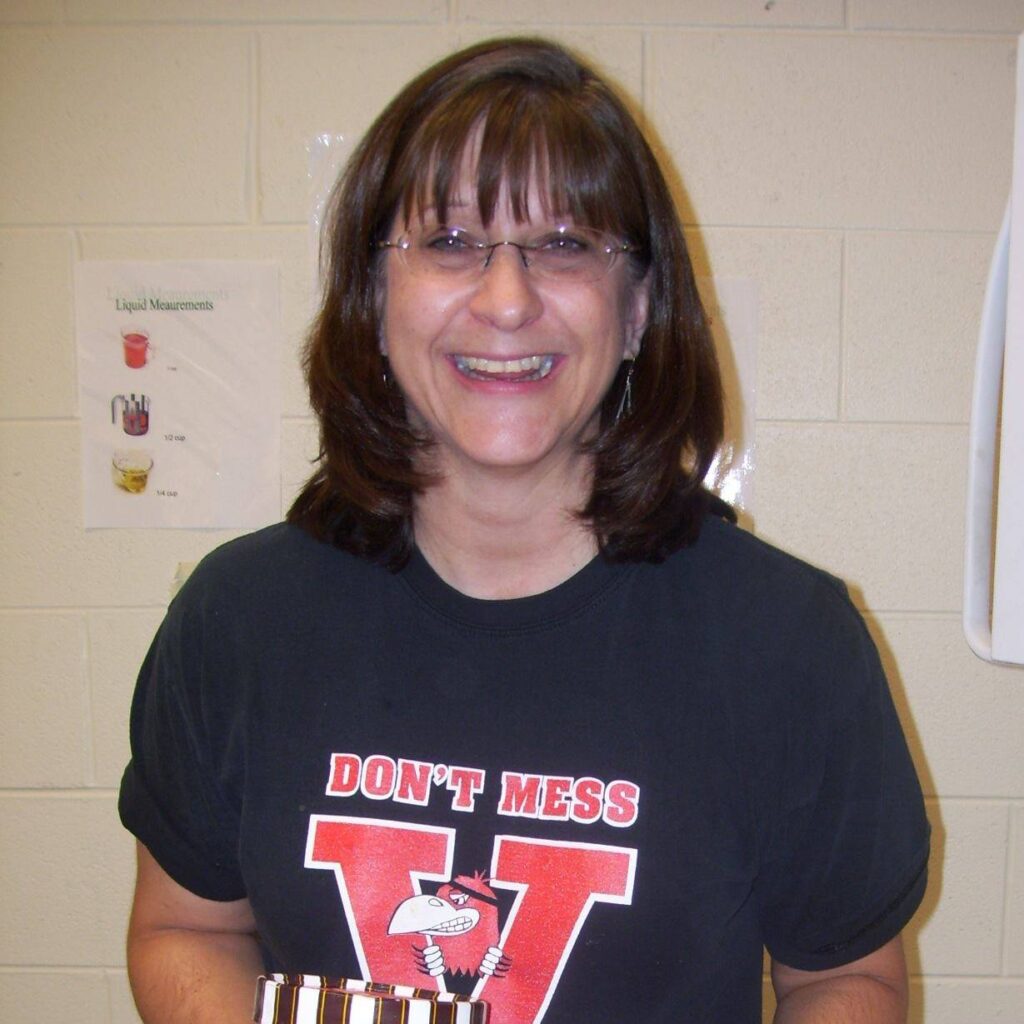
I have been a leader for the NAF. We were the only support group in Michigan. I was a leader for the Lower Michigan Ataxia group. I quit working for NAF as a volunteer and I started my own webpage, Ataxia Helps. So we have over 2000 members worldwide. I’ve got lots of people from the UK and lots of Spanish people that are for the Spanish community. I’ve got a lot of people on my website, which is nice. I think the thing that was lacking when I had the NAF is it was to a national, it was just the US. And now we are worldwide. And I must admit, I find it amazing to talk to people and find what different countries and how they approach things and how they approach disability. And some people have it really hard.
Every day the question gets answered, how long did it take you to get diagnosed? I feel privileged because it took me about two months to get diagnosed, but I was lucky. For most people it tends to take anywhere between five to twenty years to be diagnosed. And I am just astounded that doctors and nurses do not understand the depth of ataxia. They misdiagnose it as Parkinson’s, they misdiagnose it as an ear infection, they misdiagnose it as MS and people go on thinking that is what they have and only to find out later on that it is cerebral ataxia.
Some doctors just don’t have any compassion. I’ve read so many people saying, they go to the doctor and the doctor says, there’s no cure, there’s no treatment. And they leave it. That’s all they do.
It’s funny when you stop to think. I went to a neurologist here in my own hometown, and he was worthless. I mean, he looked at me and said, I don’t know how to help you. I came back, and I read the portal, and the portal note said, patient thinks she has MS. I don’t think so. I never said a word. I never said that. What? I mean, it was unbelievable. He didn’t know, and he was a neurologist.
I think you have to be your own advocate. I think you have to find a doctor who is willing to work with you and be your own advocate. I have a wonderful neurologist and I have gone to her on a portal and simply wrote to her and said, ‘this drug people find is working. Can I try it?’ And she said, ‘sure, let’s try it.’ I mean, what have we got to lose? You try it. It didn’t work for me. So we went back to what I was on or I will write to her and say, I’m not sleeping at night. My neuropathy and my legs are really bad. She says let’s increase your gabapentin or whatever. She’s been very, very supportive of me.
Ataxia Advocacy:
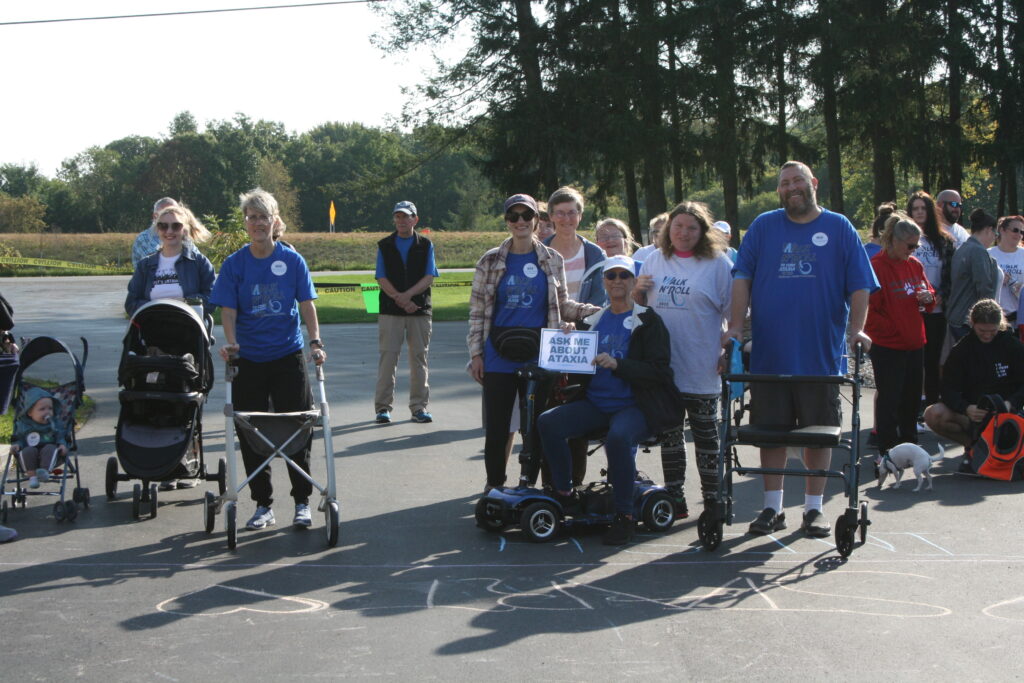
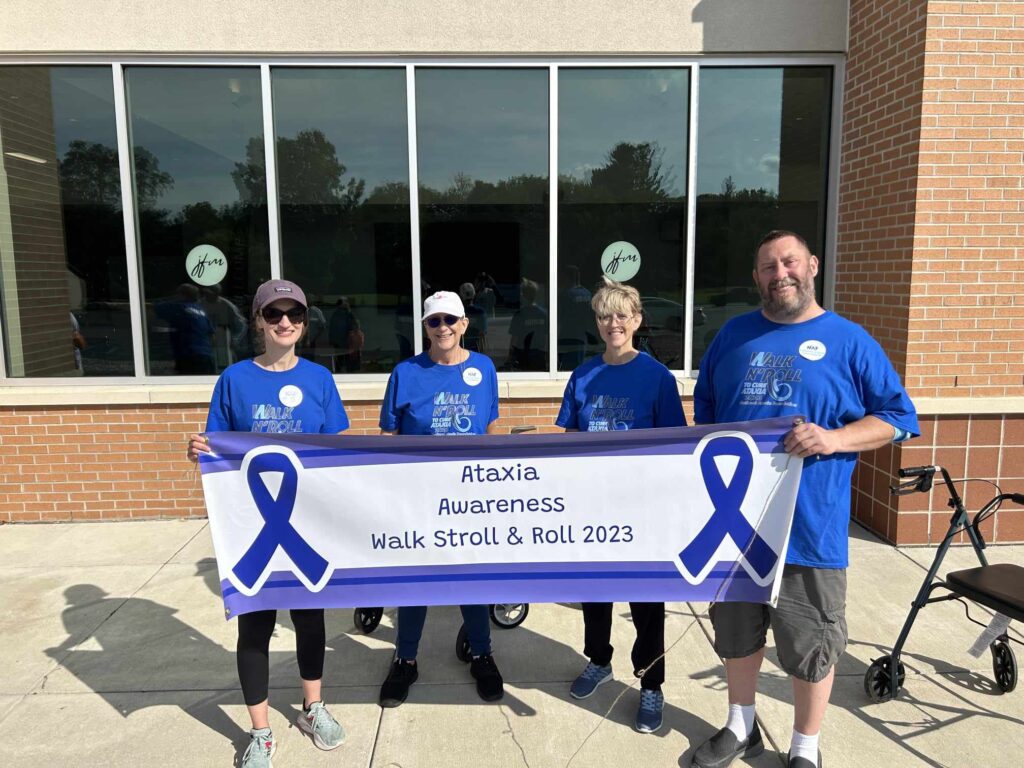
My husband’s been wonderful. He is well aware of the ataxia. But he has been a part of my ataxia journey. We did a walkathon three years ago. Our first walkathon was three years ago that he helped me immensely. And last year, we did our last walkathon, which he did most of the work. Because at that point, I was really having a hard time keeping up. And I didn’t have the extra help. So he’s really had help.
Last year, we went to the annual conference together. And he went with me. And he listened to the people. He went to the caregivers group. He’s really been involved in it.
He has met Brooke. I said, ‘this is Brooke. I’m very attached to Brooke.’ And he just met right on with her. He said, ‘ah, she’d come spend the night anytime.’ And he loved her. And she loved him. And he got on that wagon. And so he saw what ataxia will do.
I know I’ve told my husband many a times and who knows for what reason, but all along I was a special ed teacher, I was very proactive, very much of an advocate for my students. So I was advocating whether they had ataxia, whether they had cerebral palsy, whether they had learning disabilities. I was really an advocate. And I was on the outside of that disability. And all of a sudden I feel like, OK, I got it. Now, I’m in the inside part of it and I’m having to be my own advocate.
There were so many times I was someone else’s advocate and now I have my own.
Many times I still have a lot of my former students that I had when they were like second grade, third grade, all the way through high school. I still have connections with them. So we talked and a lot of times I’ll say, you know, you help me through this, Mrs. Cavanaugh. The least I can do is help you do this or whatever. They’re really good about helping me.
What comes around goes around. It really does. And that tells me a lot that I somehow have made a positive attitude with my students.
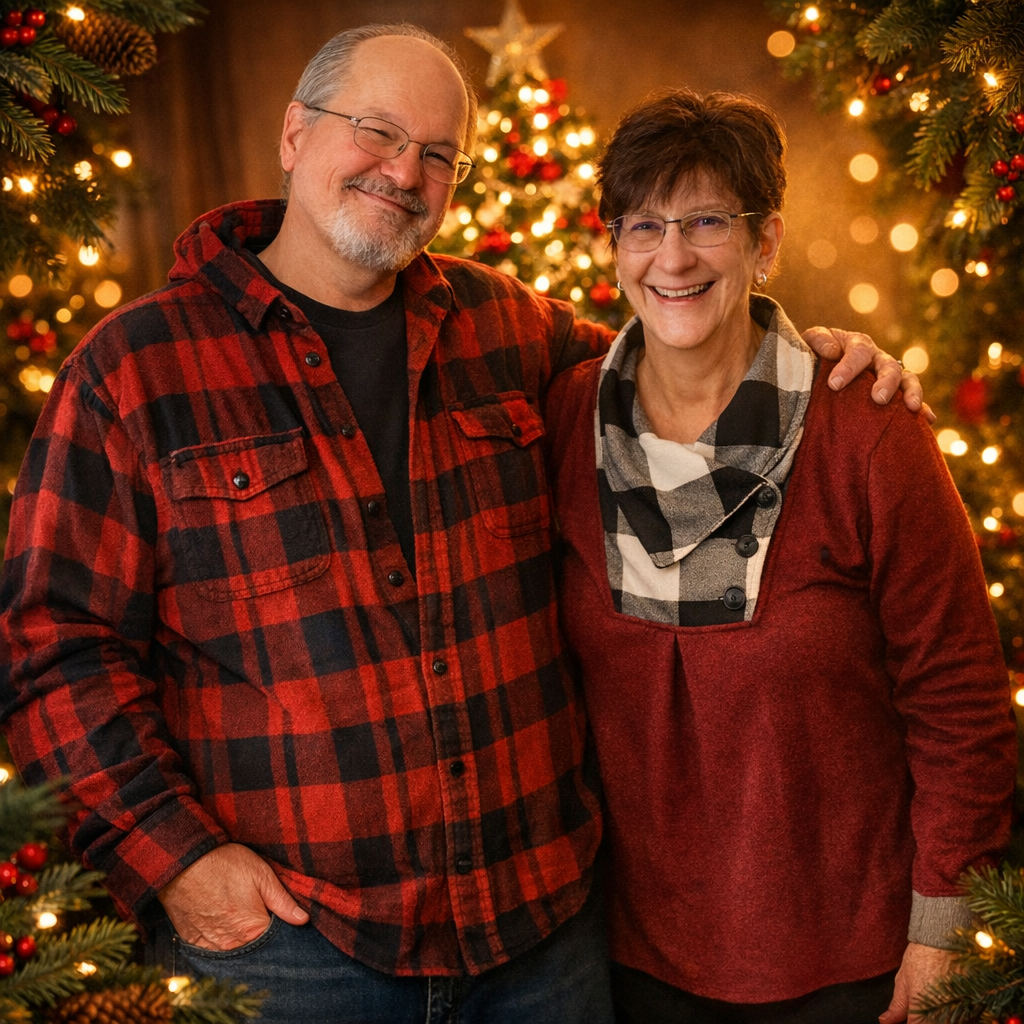
Interview and edited by: Aneurin Read
We would like to thank Brenda for sharing her inspirational story with us. If you would also like to get involved and share your experience with Ataxia or another rare condition, please get in contact with us through our social media channels or our email.
If you would like to join Brenda’s Facebook group Ataxia Helps, you can find it here (click here)