Chatting The Cerebellum Science Center With Dr Roy Sillitoe
Ataxia is a Greek word for “Lack of Order”. Our mission is to bring some order with Ataxia awareness.
As part of the Ataxia Aware project, we are sharing personal accounts of those with Ataxia or other rare conditions. We want to provide a safe space for people to talk about their experience with disability, whether themselves or someone close to them.
Who Am I?:
I’m Dr. Roy Sillitoe. I have a PhD in neuroscience. I’m at Baylor College of Medicine and Texas Children’s Hospital. I’m a researcher and a professor.
I actually spent a lot of my time growing up in Canada, in Vancouver, where I did my bachelor’s degree in kinesiology. I was always very passionate about movement, about exercise physiology, about rehabilitation. And during that time, during my practicums as an undergraduate, I actually had the opportunity to work in physiotherapy clinics alongside physiotherapists, chiropractors, and other rehab specialists. And I was the kinesiologist. And during that time, I would help in rehab for people who had undergone either workplace injuries or, in some cases, people who had come through and had some kind of genetic or non-genetic problem that affected the brain and muscle function. So, that’s how I actually got into neuroscience, was this enthusiasm I had for movement.
In my last year of undergraduate, I took a neuroscience class. And that really solidified it, along with my neuroanatomy class. I went to one of my professors, and I said, ‘how do I do this for a living?’ So he helped me find a PhD programme in a province in Alberta, in Calgary. And the professor I worked with, a guy named Dr. Richard Hawkes, he was a specialist in cerebellum, which I was kind of guided towards him because this is the key place that is involved in movement and genetic defects and non-genetic problems result in problems like ataxia, along with many other things. This was like perfect. It was seriously a dream come true because there’s not that many cerebellar specialists around the entire world. He was one province over. So, I packed up my little truck and my girlfriend at the time, who is now my wife, convinced her to move with me and I started my PhD. Once I started and fell in love with the cerebellum. And because the field is not the biggest field in neuroscience, this is when, even as a student, I started to have this dream. And I thought, there were so many aspects about the cerebellum, the function, the development, the anatomy, the different diseases. And this is when I started to imagine. I said, ‘imagine if there was a place where there were many different cerebellar researchers doing all of these things.’ And I was like, what would that be like?
The Cerebellum Science Center:
I then moved on to a postdoc because I did neuroanatomy and embryology. I realised I needed more molecular biology, particularly because I was starting to become interested in diseases. And a lot of these diseases are genetic-based and the way to study them is from a molecular basis.
I did my first postdoc at Oxford University studying molecular neuroscience and different neuromuscular diseases. During that time, mouse genetics specifically became a big deal because using the mouse as a genetic model system, we could actually much better understand human genetics way quicker. So these two fields, human genetics and mouse genetics, were kind of developing together. And in New York was a lab who studied the cerebellum and mouse genetics. So I went to do a second postdoctoral fellowship in New York. So I actually was very fortunate to start my lab at Albert Einstein College of Medicine in the Bronx after my postdoc. I started to dig into how do we control different circuits in the cerebellum? And when things go wrong, what happens? And it was more from a basic understanding of when the cerebellum doesn’t function. Then in 2011, I came down to Houston to visit a really good friend of mine who had just started his lab at Baylor College of Medicine. And when I came here to visit, I met who is now my director, Dr. Huda Zoghbi. And she was the one that discovered the spinocerebellar ataxia type 1 gene in 1994.
I was here for one day and I gave my seminar, at the end of the day, my last meeting was Dr. Zoghbi. And she says, ‘I would never do this to any junior professor, but she says, you need to move here. This is where you belong.’ One of my other close friends who was in Pennsylvania, Javier Medina, he’s an electrophysiologist who studies cerebellar motor learning. He was being recruited to come here. I’m thinking, is this a possibility? Are we all going to move to Houston and study the cerebellum like this? And we did. We all moved here.
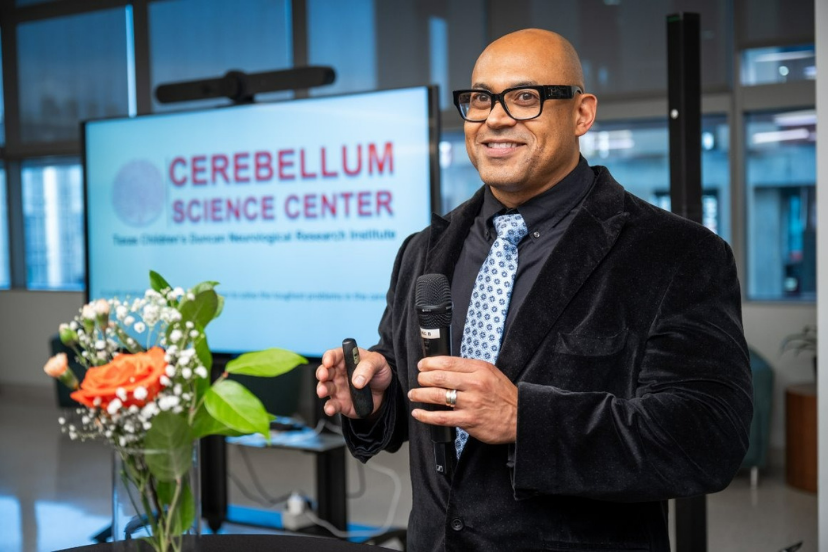
Fifteen years went by and then two years ago I was having lunch with Dr. Zoghbi. I said, ‘you know, I’m never satisfied. I always want more.’ And she says, ‘what do you want to do? What’s next?’ I said, I want to do something really big. It’s something I’ve been thinking about literally since the 90s. I want to start a cerebellum science centre’. I said, I want this Houston-wide. We have the biggest medical campus in the entire world. This is the biggest hospital system in the world right here in Houston. I said, I want to integrate without boundaries every single person from neuro-oncology, neurosurgery, basic neuroscience, neuropsychiatry, rehabilitation, anybody who has expertise and interest in the cerebellum, I want us under one umbrella so that when we start to tackle problems in cerebellar disease, it’s not me spending the next six months trying to convince a collaborator that this is an important problem. It should be a five, ten-second phone call to somebody and say, I have something. Let’s assemble a group of 10 to 15 experts from different areas, and we need to solve this challenging problem.
So we started the Cerebellum Science Centre. And we now have 65 different faculty. And this is why I wanted a centre like this, is that we can finally start to tackle these issues.
What We Can Learn:
If you look at the last, you know, 100 years of research, it will tell you that the cerebellum and the Purkinje cells are involved in movement. Then you have a patient with ataxia, let’s say, who has not only movement problems, but they might have sleep issues as well. They might have breathing issues. They may actually have cognitive problems as well. And then you’re kind of puzzled and say, well, I thought I had a cerebellar disease. What else is wrong? Well, my answer to that is that because of the extensive connectivity and function of the cerebellum, it doesn’t function alone, but it can contribute to all of these problems. There’s evidence that it controls heart rate regulation.
So when things go wrong in the cerebellum, many systems in the body go wrong. I actually published a paper some years ago in MICE with my chairman of pathology. We found that in fact, that changes in the gut microbiome affect activity in the cerebellum. So my point is that when you think about the cerebellum, you cannot only think about movement. And when you think about the problems in these different disorders, there may be a chance, and this is not always, but there may be a chance the cerebellum is involved in everything else. So that if we can fix cerebellar issues, there is a possibility that we can fix other life-threatening issues in many of these disorders.
Understanding ataxia will teach us about Alzheimer’s. Understanding the cerebellum will teach us about cancer, not just movement. And then of course, we have gone so far in science. There’s many different therapies that I think we can push. I know there’s been a lot of trouble with drug therapies. This is not a trivial thing to develop drugs. It’s not trivial to develop gene therapies. I’ve been in that space as well. And in the last 15 years, I’ve been more in the space of developing deep brain stimulation technologies for the cerebellum. And I think there’s tons of promise in that. So for me its important to bring therapies into a much more productive discussion. Because I think when we think about therapies it’s a mystery to what people are doing. I don’t think the community knows what people are doing. And then unfortunately, when they hear about a failed drug trial, they don’t know what actually worked. It’s also how to integrate all of these modern therapies to come with rehabilitation, which we know in some conditions can work very well, whether it’s motor rehabilitation or whether it’s speech therapy, these things do work. But how can we make them work better, especially if we pair them with different other therapeutics as well? I’ll give you the best example I have. Actually, for Parkinson’s disease, deep brain stimulation can work very, very well. But the best cases where deep brain stimulation in Parkinson’s works well is when it’s paired with a drug levodopa. So in this case, you have to have levodopa and the DBS to get the benefits. So paired therapies and combinatorial therapies, I don’t see how that can’t be the way to go forward.
The Exciting Developments:
I’m working a lot on Deep Brain Stimulation at the moment. We are now taking everything I’ve done in mice in the last 15 years and moving this to human patients now. I honestly didn’t ever think that I was going to get to this point as one person who I could actually make an impact by assembling the right people. And so this is what I’m very excited about. And the studies that we’re looking at cover several disorders from ataxia to dystonia to cerebral palsy. All of these issues have a lot of common themes. And again, what we solve in cerebral palsy a lot of the kids with cerebral palsy have ataxia. What I learned from those children, we are going to be able to apply to SCA one, SCA two, SCA three, and all the other SCAs because it’s the same network. It’s the same cells.
So this is why I’m super excited in not just the deep brain stimulation, but we’re also doing and just starting a big initiative on non-invasive stimulation as well. There’s several ways of non-invasive stimulation. The one we’re thinking about right now that we already do here is transcranial magnetic stimulation. And you can put a magnetic coil in different areas above the brain. At the most, in some cases, you might have to shave a bit of your hair, but this is all totally non-invasive. You basically direct a magnetic field through the brain in different regions. I want to be careful because we don’t know the mechanism but if you have abnormal brain activity, you can somehow interfere with those abnormal signals and get those circuits to a place that they function in a more productive way. What we’re trying to do is focus the field towards the cerebellum non-invasively.
The person could come in for literally 5 to 20 minutes and be stimulated and you’re going to see an impact. And this has worked for different disorders. The problem is that it doesn’t last forever. You have to keep coming back. But again, this is non-invasive. What we’re trying to tap into is a lot of the work in my lab has been focused on understanding plasticity in the cerebellum. With different experiences, with different levels of activity, you can actually induce changes in the cerebellum that may be long lasting.
The Hope For The Future:
So I think the hope now is that we have finally gotten to a point that if you were to reverse about even 10 years ago, if you had an ataxia and you didn’t have one of the known spinocerebellar ataxias it could be quite stressful. Your neurologist says you have ataxia as a symptom, but you actually don’t know what the disease is. We now have the technology with the genetics and the sequencing that you can actually diagnose these. And it doesn’t solve the problem, but from my understanding, from talking to many different patients and different families, knowing what you have makes a huge difference. So I would tell somebody, if you don’t know what you have, there are places around the world now that you can actually have a chance to figure out what you have. And that’s the starting point. Once you know what type of ataxia you have, now you actually set up to see what are the available therapies and rehab approaches that might be available. At this point, it’s to help your quality of life, and it is a start. And I’m going to be honest, that doesn’t solve the problem. We know that. But the hope is that there are people like me, and there are several of us, and we are gaining more that have devoted our entire lives.
I’ve been doing this for thirty years. And we intend to spend the next 30 years doing it. We have finally gotten to a place that I can assemble people like myself and the clinicians, because even though I’m a scientist, I can’t do this alone. I would say the hope now is that we have people who are stubborn enough like myself that I will not give up. We have got the right people finally in the room together. And my hope and my passion and my devotion to every one of these patients is that I will literally die in the lab trying to solve these problems. I’m not going anywhere.
I think it’s important for people, especially in the ataxia world, to understand, you know, just how devoted we are. It’s very difficult to raise money to solve these problems, but that has not stopped us. As scientists, we work night and day, to make sure we have money, getting the right students, the right postdocs, training people, giving lectures. So it’s been quite a career but it’s one of those careers that you never stop. There is no rest. And I am happy to keep doing it. We have to devote our lives to it. And I want people out there to know that we do.
I think people need to not be afraid to ask us. I want people to be able to reach out to us as scientists. And I will say for me specifically in the ataxia and cerebellum field, I want to start as many discussions. People should not be afraid to reach out to the professor scientist. Please reach out. Even if you have the silliest, simplest question, it’s not a simple, silly question. It’s an important question. And that dialogue is what I want people to be able to. We’re here for you. We’re here for the community. So my message is, please reach out and talk to us. And we want to speak to people. And many times as scientists, we don’t get the opportunity to, because of the structure of how it is. We come to work, we go to the lab, we go and teach, and then we go home and then we do the same thing the very next day. But if we can interrupt the cycle that much of my time is spent talking to the community, I would be very grateful for that opportunity.
Stay hopeful, stay positive, because we want to conquer these disorders once and for all. So stay hopeful and stay positive.
Content provided by: Dr. Roy Sillitoe
Interviewed by: Aneurin Read
We would like to thank Dr. Roy Sillitoe for sharing his incredible journey with us. If you would also like to get involved and share your experience with Ataxia or another rare condition, please get in contact with us through our social media channels or our email.
If you would like to know more about The Cerebellum Science Center, you can follow them on Instagram.