
The Carers Perspective:
Ataxia is a Greek word for “Lack of Order”. Our mission is to bring some order with Ataxia awareness.
As part of the Ataxia Aware project, we are sharing personal accounts of those with Ataxia or other rare conditions. We want to provide a safe space for people to talk about their experience with disability, whether themselves or someone close to them.
About Me:
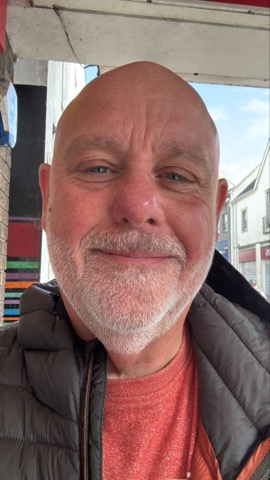
I’m just Karl. I’m a paid and unpaid carer, so I’m a bit of both. Because my working background is in care, I get paid. I’m a respite officer for a local charity. I look after mostly teens whose parents need respite, or they need respite, so that everybody can have a break from each other. And then my unpaid work is making sure that Louise has support and care but I also do a thing called direct payments with her, and I get paid for that, but you do more hours not getting paid than you do get paid in care work. So, I know both ends of it.
Caring for Louise:
When I wasn’t working much as a carer, I was with Louise full-time at home and I was still working part-time. What I noticed is that I was doing things for Louise, and I knew she could be doing these things herself. She literally reminded me all the time, ‘I can do these myself’. But you get into the habit of ‘I need to do this for Louise’ but what I was doing wrong is not letting her do it herself. Because you’ve got the carer role in your head, sometimes you need to take a step back.
Me and Louise are getting divorced. Since I’ve moved out, what I have noticed is Louise has found more of her feat. She’s doing a lot more things for herself. I can see the improvements in areas where I used to do things quite a lot, and she didn’t ask for me to do those things, she asked me to take a step back. She’s a lot more independent, and the care that I give her is more quality. I’m prompting a lot more than I ever used to prompt. For example, she might be going on the pavement and you’ll tell her, ‘Louise, there’s a bit of a hole in the pavement there, or a bit of a bump, be careful’, just a prompt, whereas before, I would probably help guide the rollator over the bump.
It’s tough being separated from Louise, it’s a roller coaster of emotions. But the care I’m providing for Louise is less in quantity but more in terms of quality. We must remember that Louise has been my carer too. I’ve been ill in the past as well, and she was there for me caring, and to a point, everybody’s a carer.
When Louise first had the ataxia, even up until maybe two years ago, I did see the ataxia more than Louise. That’s why I feel the marriage has broken down. I must tell people that, with Louise there hasn’t been bad situations in that marriage. The ataxia and all the other stuff that come with it, it’s not just a strain on the one who’s got the condition, it’s a strain on the ones looking after them. I felt that I couldn’t give Louise what she needed. But now since we’ve parted, I see Louise more than the ataxia. So maybe I needed to be out of that circle to look properly at what’s going on, because when you’re in that circle, you’re blinded in a way. You don’t think of the person in front of you, you just continuously think of the rare disease. The ataxia is there and it needs to be recognised, but the person with that rare disease needs to be recognised even more, so that they can live a fulfilling life. The rare disease does not come alone.

Understanding ataxia as a carer:
I didn’t know much about ataxia, but the best way to know is not through books or YouTube. Be with the person who has ataxia, watch and observe what their life is like throughout the day. Especially if they’re a loved one in the family, or you’re used to friends who have got ataxia. By watching them, you’ll get to learn about ataxia in many ways. I’ve read all the information on ataxia and seen all the YouTube clips. You can understand what ataxia is all about. It doesn’t prepare you for being in that moment with the person with the ataxia. The one with the ataxia will show and teach you what they are going through.
With the ataxia patients, there’s one thing they’ve all got in common, and that’s fatigue. They’re constantly drained and tired. When they are, the little mistakes start coming in, like maybe they’re picking up their tea, and they’re so tired, they might drip and burn themselves. You can see when all this is kicking in, you look, you take a step back, and then you can come in. If you’re a really good carer, you just don’t jump in and say, ‘oh look, you’re spilling your tea’. You go in like, ‘do you want some help with that? Is there anything I can do for you? You look tired, and is there something you want me to do?’ And 99 times out of 100, they’ll say, ‘oh yeah, can you put the cup down for me, or can you tip some of the tea out’, or ‘can you wipe the table?’ But, if you give them that space in asking them what they need, not presuming that you’re going to do it for them instead of just jumping in there, because that takes their dignity away.

The Importance of Independence:
When you’re caring, you’ve got to realise sometimes you’ve got to put yourself in their shoes. Sometimes when you’re caring it can get very frustrating. You know what they need, and you know what you need to do for them, but if anybody’s suffering with cognitive impairments or anything like that, you cannot hurry that along. I care for someone who you’ve got to break the food up, put it in between two of his fingers, and then he’ll eat it like that. Sometimes he gets frustrated and he doesn’t want to do that, so you’ve got to feed him. These sorts of things in care work all count. Some people might think, ‘oh what a fuss, let them carry on.’ No, what you’re doing, you’re trying to promote independence for that person as well. So, independence is very important when you’re caring.
Carers come in and they want to get the job done as quickly as possible, so they do everything for the client. They’ll feed them, clothe them. But you’ve got to think back in your mind, ‘can they actually do this themselves?’ I tell people who care for clients don’t let them think that you can do everything for them, they need to do it for themselves.
Looking After Yourself as a Carer:
I have grown in a way but because I was super busy with myself, busy with my mind. I’m in my flat, I come home from work and I work some nights. I work until eight, nine o’clock at night, so when I come home, I make myself some food. I like listening to the radio, I’m a big music fan so I could even put the music on. I’ve learned to relax more, settle down, have a bite to eat and then I go to bed much earlier than I used to. I’m in bed most nights about 11ish, where I was going to bed at two in the morning. I now like to give myself time. Give myself time to think and to connect.
I was too busy in my head with things I didn’t need to do. Louise has taught me a lot as well. She’s taught me how to be more caring to myself, how to relax and not give her so much care. Because sometimes she wants to care for her as well. I’ve learnt a lot from Louise, she’s learnt a lot from me as well, we have been inclined to learn a lot from each other.
The Importance of Having Spaces:
People Speak Up give that space to people who are having care and who are giving the care. The community spaces are very important, and we need more of them. You need one group where people can talk about different illnesses they’ve got, because there’s not enough grants and money to start different groups around the country. I think it should be one hub where anybody is welcome with any condition who needs to go to a hub, talk about their problems, or maybe not talk about the problems, just join in and do normal things.
I’ve been with PSU and they did some for a dementia group. I loved it, they talked about the past, music, there was a dance, all these things matter in people’s lives. There’s no community like when I was growing up, that community’s gone, but where there are communities are in these hubs, and it’s really important to keep those hubs going with grants and funding. We need them desperately, so people can feel a part of that community, they need to feel wanted and recognised.
People who are being cared for by carers also become lonely and isolated. Both the carer and cared for can experience loneliness and this can lead to community loneliness as well and can be difficult to overcome the loneliness when no one gives any input from a professional background and voluntary organizations in the last ten years have had their befriending funding taken away.
Written by: Karl Treharne
Edited by: Aneurin Read
We would like to thank Karl for sharing his very human story with us. If you would also like to get involved and share your experience with Ataxia or another rare condition, please get in contact with us through our social media channels or our email.